 LotsSocial
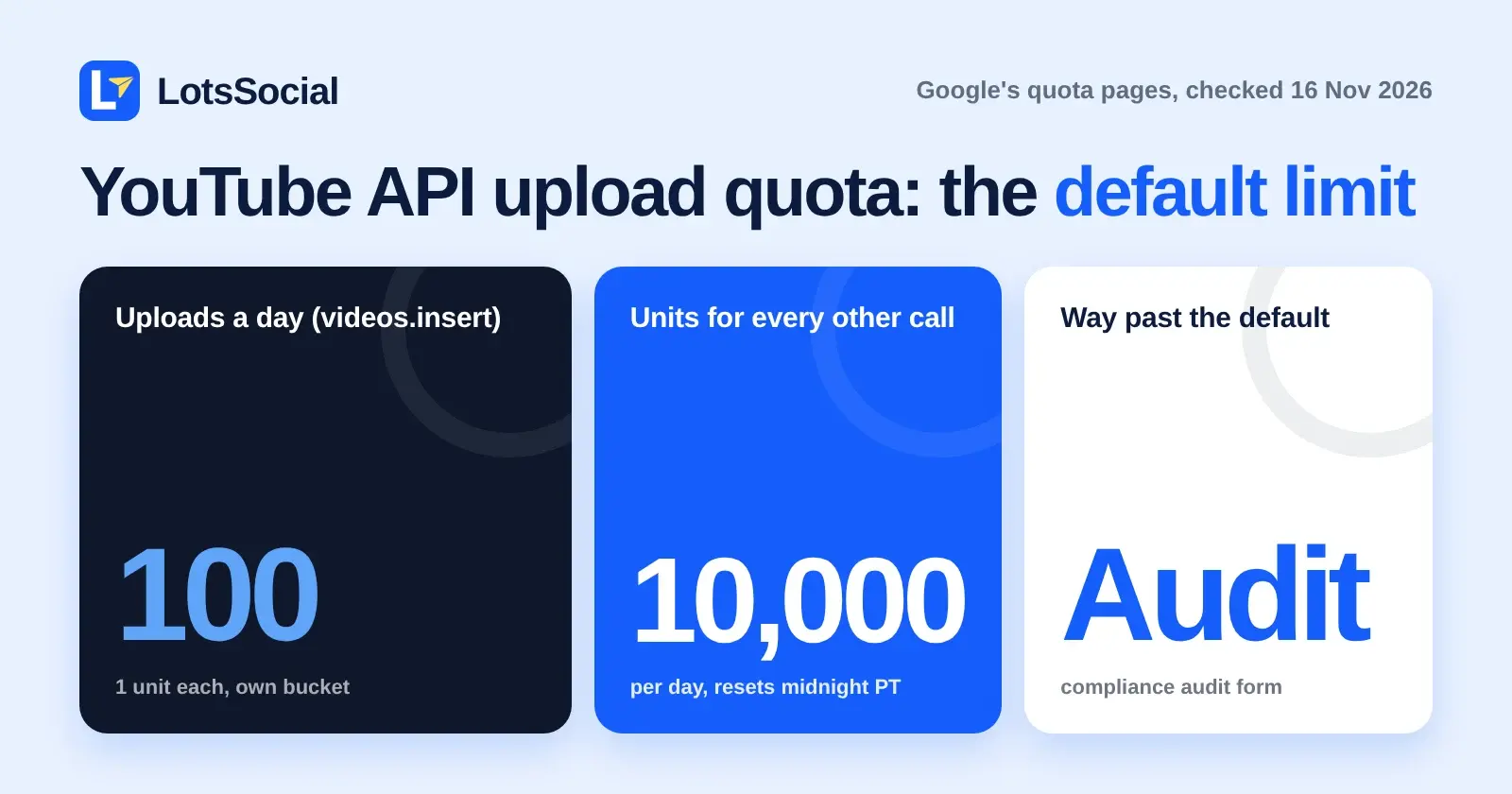
A new YouTube Data API project starts with 100 videos.insert calls a day, 100 search.list calls a day and 10,000 units a day for every other endpoint. Google's own pages say each upload costs 1 unit in its own Video Uploads bucket, and the only way past the default is a compliance audit. I checked Google's current pages on 16 November 2026.
I run LotsSocial, which publishes to YouTube for you, so I read these pages the way someone building their own uploader would. Here are the numbers, the audit rule and what it means in practice. Every figure is from Google's pages, linked at the end.
YouTube Data API upload quota at a glance
| Default for a new project | |
|---|---|
videos.insert (upload) | 100 calls a day, in its own Video Uploads bucket |
search.list | 100 calls a day, in its own bucket |
| Every other endpoint, combined | 10,000 units a day |
| Cost of one upload | 1 unit in the Video Uploads bucket |
| Reset | Midnight Pacific Time |
| Maximum upload file size | 256 GB |
Google's quota calculator page (last updated 12 November 2026) says all of this in one paragraph: projects that enable the YouTube Data API have a default allocation of 100 search.list calls, 100 videos.insert calls and 10,000 units per day combined for all other endpoints. Even an invalid request costs at least one unit. You can watch your usage on the Quotas page in the Google Cloud console.
The videos.insert reference page repeats it: "Quota impact: 100 calls per day. A call to this method has a quota cost of 1 unit in the Video Uploads quota bucket."
What the 100 uploads a day really means
The two buckets change the maths. Uploads no longer eat into the 10,000 units, so a project that uploads 100 videos a day still has all 10,000 units for everything else. Two things still count against you.
First, the other calls that go with an upload cost real units. From Google's cost table:
| Call | Cost in units |
|---|---|
videos.list, channels.list, playlistItems.list | 1 |
videos.update | 50 |
thumbnails.set | 50 |
playlistItems.insert (add to a playlist) | 50 |
captions.insert | 400 |
captions.update | 450 |
My arithmetic, not Google's: if every one of 100 daily uploads also sets a custom thumbnail and joins a playlist, that is 100 x 50 + 100 x 50 = 10,000 units, the whole daily allowance, before a single caption or edit. Setting the title, description, tags and publishAt in the upload request itself costs nothing extra.
Second, search.list is capped at 100 calls a day and each extra page of results is another call. If your uploader looks videos up by searching, switch to videos.list or playlistItems.list, which cost 1 unit each in the main bucket.
Do uploads from an unverified project go private?
Google's videos.insert reference page says no. Under status.privacyStatus it reads: if you don't set a value, the uploaded video defaults to public, and certain uploads might default to private based on creator account settings. It then adds: "Videos uploaded from unverified API projects are not restricted to private viewing mode."
That is worth noting because many guides say an unverified project can only upload private videos. If you plan around that rule, check it against the line above first. The creator's own account settings can still make an upload private, so set privacyStatus explicitly and read the result.
How to get more YouTube API quota: the compliance audit
Google's Quota and Compliance Audits page (last updated 12 November 2026) is short and clear: to request more quota than the default, you must first complete an audit that shows your project complies with the YouTube API Services Terms of Service. The developer policies add that you apply for an extension by completing an API Compliance Audit and "must specify the use case for which you need the extension".
The audit goes through a single form, the YouTube API Services Audit and Quota Extension Form. Here is what I saw on it:
- Request type. You pick a compliance audit for more quota, or an audit to keep your current quota if YouTube asked you to re-audit. The form says all requests for additional quota go through a compliance audit.
- Who you are. Organization and contact details, your business model, and how your work relates to YouTube. The form says applications that can't meet the requirements, including demonstrating significant independent value to the YouTube ecosystem and its users, may not be granted additional quota.
- Evidence per project. Screenshots that show your Privacy Policy and Terms of Service, an architecture diagram and user flow diagrams (optional but recommended), and OAuth consent screen screenshots if you use OAuth.
- For uploaders, a working demo. The form says static screenshots alone are not enough for a video-uploading use case. It asks for either a complete, working upload script (not a snippet) or an end-to-end screencast showing the full flow through to the finished video live on YouTube.
- Numbers. Expected daily request volume, the endpoints you use, and the exact quota you want per day, with a justification. You can ask separately for
search.listandvideos.insert, because the form says the general quota covers every endpoint except those two. - Demo account. If you provide demo account credentials, the form states that Google is not bound by any terms of service or privacy policy that would normally apply to that account.
YouTube's page also lists the other audit paths: an additional quota extension if you were found compliant within the last 12 months, an appeals form after a failed audit, a periodic audit form if YouTube contacts you, and a change of control form if the company behind the project is sold or merged. The page says a member of the API Services team will contact you "as soon as possible"; it gives no turnaround time and no guarantee of approval, so I would not plan a launch around one.
Two more rules from the developer policies apply the moment you get access:
- Use the extra quota only for the approved use case. If the use case changes, you must resubmit the audit and get approval before using the quota for it.
- Inactivity. YouTube reserves the right to disable or curtail access if your API project has been inactive for 90 consecutive days.
Is the default enough for your own channel?
For one channel, almost certainly. 100 uploads a day is far above what one creator publishes, and the 10,000 units cover reads and edits. The default stops being enough when you upload for many channels from one project. Each upload still costs 1 unit in the same bucket, but the 100-a-day cap is per project, not per channel. A scheduler or agency tool that serves many accounts from one project hits it first.
Building your own uploader also has fixed setup work. Google's upload guide has you create a project in the Cloud console, enable the YouTube Data API, create an OAuth client ID and authorize the youtube.upload scope. After that you maintain refresh tokens, retries and resumable uploads yourself.
Posting to YouTube from LotsSocial without your own API project
If what you want is videos on your channel, not an API integration to maintain, that is the job LotsSocial does. You connect your YouTube channel with Google sign-in. Then your AI agent (ChatGPT, Claude, Claude Code or any MCP client) or the dashboard calendar publishes to it with a title, description, tags and a visibility you choose. There is no Cloud project to create and no audit for you to file.
YouTube is one of 11 networks on the same calendar, with LinkedIn, Instagram, X, Facebook, TikTok, Threads, Pinterest, Bluesky, Mastodon and Google Business. Plans cover 12, 40 or 150 connected accounts for $20, $59 or $149 a month. Without a plan, each account is $2 a month from credits, charged daily. Posts, media storage and brands are unlimited. Prices are from lots.social/llms.txt on 16 November 2026; the details are in LotsSocial Pricing Explained.
I wrote the same kind of page for the other networks, so you can compare what each platform asks of a developer: TikTok Content Posting API, Instagram API publishing limits, Threads API, LinkedIn API access and X API pricing. For a wider comparison, see The Best Social Media APIs for Developers. To see how sign-in and permissions work, read Is LotsSocial Safe? and How to Connect Your Social Accounts to Your AI Agent.
FAQ
What is the default YouTube Data API quota?
A project that enables the API gets 100 search.list calls and 100 videos.insert calls a day, plus 10,000 units a day combined for all other endpoints, according to Google's quota pages checked on 16 November 2026. Daily quotas reset at midnight Pacific Time.
How many videos can I upload a day with the YouTube API?
100 videos.insert calls a day per project by default. Each call costs 1 unit in the separate Video Uploads bucket, so uploads do not use the 10,000-unit allowance. Calls such as thumbnails.set and videos.update still cost 50 units each from the main allowance.
Are videos from an unverified API project private?
Google's videos.insert page says they are not restricted to private viewing mode. A video defaults to public if you don't set privacyStatus, and some uploads can default to private because of the creator's account settings. Set the status explicitly.
How do I get more YouTube API quota?
Complete a YouTube API compliance audit with the Audit and Quota Extension Form, naming the use case and the quota you need per day. You can request search.list and videos.insert separately. For an uploader, Google asks for a working upload script or an end-to-end screencast. If you were found compliant in the last 12 months you can file an additional extension request.
Do I need my own API project to post to YouTube with LotsSocial?
No. You connect your channel with Google sign-in and LotsSocial publishes through its own connection, from your AI agent or the dashboard. You don't create a Cloud project or file an audit.
Sources, checked on 16 November 2026
Google for Developers: Quota and Compliance Audits (last updated 12 November 2026), Quota Calculator (12 November), Videos: insert, Upload a Video, YouTube API Services Developer Policies and the Audit and Quota Extension Form. LotsSocial details from lots.social/llms.txt. Google changes these pages; check them for the latest.